This term, a Japanese friend asked me to take a class with him. It is much different than the typical classes I am made to take here in Okayama. This particular class is based on studying Southern Oregon. Basically, I took it for two reasons. First, I wanted to get more practice listening to Japanese in a class room setting because my other classes are taught in English, typically with a Japanese instructor, who's English isn't flawless to say the least. And second, I wanted to see first hand how the Japanese students are taught in college as opposed to how American classes operate.
I first want to outline my experience, and the experience that I imagine most American students have while studying at home. In America, classes are typically somewhat difficult, and some are outright intense. The professors often assign homework such as reading of text books or answering questions on a daily basis, and in many 10 week classes, there will be 3 tests including a final, and often 2 or 3 essays of between 3 to 7 pages accordingly. As students, much of our time outside of class is spent studying material, and in alot of cases, it is our job.
For another point, the Professor usually wants student engagement to take place during their lecture. It's seems that the common belief is if you don't make the students answer questions and give their 2 cents, they probably aren't learning the material. I have seen, in many classes, a professor continuously looking for people to ask questions when a difficult topic comes up, and if no questions are asked, the teacher gets somewhat annoyed with the class. As a student, I love to give my understanding of something and be corrected if wrong, as well as here other students' questions because they often clear up questions that I have as well.
Now, I would like to explain my experience it the "Japanese class" that I am taking. I can't speak for all classes, or even universities, but according to other students, most classes are structured quite similarly to this one.
Firstly, the Professor does assign homework at the end of each class, but unlike American classes, the ones here are only 90 minutes one day a week. The homework usually seems simple, and the students have a full week to do it. In this class, there will be no essay to write, and i believe just one small test at the end of the term which lasts 15 weeks.
As for how the actual class period operates, I am very surprised. There is no required text for this class, which is understandable because "Southern Oregon" is somewhat of a strange topic. So, instead of a text, the Professor makes print outs of the "Ashland Daily Tidings" newspaper for the students. For the first 30 minutes, he just stands at the front of the class and reads a sentence in English, and then translates the meaning. He only makes it through about the first two paragraphs in that time, and then moves on to another print out. One time, he gave a "Google Map" of a piece of a city, both here in Japan, and in the states. The purpose was to examine the differences between Japanese and American maps, where there are actually quite a few. This is a typical class period.
During all of this, I look around at the sum 30 students, and can usually see about 10 that even look awake, and out of those, maybe 5 are following the lecture. The Professor almost never asks a question, and the students are completely unengaged, just listening to the man ramble on. I really wonder how someone can learn from this first off, and why someone would pay money to sleep in a classroom while some half balding man shouts information at them.
Like I said, this is a very usual Japanese college class. In a few weeks, i will have the opportunity to go to a High School here and sit in on one of those classes as well. I am very curious to see if they use to same strategy for teaching.
Friday, May 21, 2010

Friday, April 30, 2010
Becoming Me
Hey friends!
It has been far too long since I last posted about my stay in Japan. Alot has happened since January, and I have alot to tell. I am sorry if this post drags on for a while, but please read through to the end!
I began my second semester about three weeks ago now. So far, it is proving to be much more enjoyable than the previous one. Last time, I took many classes that were very tedious, and were basically just sitting in a class room, and not learning very much. This term, the class options are much more activity orientated. I am taking Japanese 2, which will be better for me because it shouldn't be a repeat of what I learned previously. The Study of Japan, which involves field trips around our region. Last week, we went to Bizen, famous for its pottery, and made our own dishes! Also, we saw the oldest public school in Japan. It is no longer in use, but was interesting to see a little of Japanese origins. I am in a class called "The Intangible Heritage of Japan". In this class, we are learning through hands on experiences. We are currently making Japanese pottery, and will also make our own chopsticks in a wood shop type setting, and learn to play the very famous Taiko drum. Finally, I am taking "The Political Economy of Modern Japan". This class may seem a bit boring, but I assure you that it is full of interesting facts. So far, we have studied how the Japanese overcame the economic collapse after WWII, and also during the 1970's with the fuel shortage scare. In full, we will basically find how Japan went from an under developed country before the war, to one of the worlds major economic powers in the current day. I am very excited to see these classes through to the end.
Grievances and Troubles
I explained in an earlier post, that the foreigners here in Japan have a very tough time with many aspects of life. I have found myself being part of the most extreme minority that Japan has; white people. First and foremost, I have never been in a minority situation before this, and for a long time, I wasn't quite sure how to deal with and overcome it. The country is nearly 98% Japanese, and out of the remaining 2%, about .01% of the people living here are white. The rest of that small portion is mostly other Asians. For westerners in general, but specifically Americans, this is a very hard fact. Let me explain. I was raised, much like most American kids, with the idea that it is fine to be different, and in mot circumstances, difference is wanted. Our country is made up of countless cultures, and with that brings countless traditions and ways of life. This makes our great nation very diverse, and makes an "American Culture" very hard to pin point. In Japan, with everyone being Japanese, the culture has been left almost unchanged for a very long time. Built into their culture, is the idea that difference is unwanted, and that the herd should be followed; very closely. This is an issue that aches at me everyday.
The idea of no difference within the culture brings smaller issues for me as well. Its very hard to make friends first off. After 7 months, still I have just one good friend that invites me to do things and treats me as an equal. I am usually with other foreigners, who accept each other, and it is somewhat ruining the mental image that I had before arriving here, of never being with foreigners to make the best of my experience. In some ways, it is making me dislike the Japanese people, which I don't like say.
Leading directly from the point of not having Japanese friends, brings up the fact that my language level is still disgustingly low. 7 months, and still, I can't hold a conversation. I know how to speak, and I can understand a great amount of what is said to me now, but when asked a question, I don't know what to say, and just stumble. I believe that this is due to not practicing. I know it seems obvious right?! "Just practice then"! But, it really isn't that simple. The Japanese take any chance to speak English they get, even if it's with someone here that speaks french or German, and always turn a conversation to English.
This may sound a bit blunt, but I suppose, due to being white, I have never encountered direct racism toward me. That is, until about a month ago. I really didn't see it coming. Not in Japan, not in a thousand years. The Japanese tend to be very kind, at least to your face. Recently, I have found that many of them wear a mask so to speak though, and are only polite due to cultural rules. Allow me to tell you a little story. I went to small town about 15 miles from where I live called Kurashiki. It has a very beautiful traditional district, made up of old style buildings and small irrigation streams. I went during the famous "Sakura viewing" (Cherry blossoms) time. As we walked out of the train station, we stopped to stand in the nice sun shine for a few moments. There was man and woman sitting on the benches behind us, maybe in their mid 40's. Once they noticed us standing there, the man started yelling all types of things at us. In Japanese of course. (Because we're white, most Japanese don't think we can understand even the smallest bit of Japanese. He was mistaken) He was yelling things like "Oh white people! HAHAHA!" "OH, Americans!!! HAHA" "Who do they think they are?!" This was said in a very nasty and hateful tone. Just as we decided we'd had enough, and began to walk away, he yelled one final remark. "AH, PERO-PERO!" I admit, I didn't know this word, but my handy-dandy electronic dictionary sure did. I looked it up and found that it means "to lick with the tongue". Usually used as a verb for eating something like an ice cream cone, or lolly pop, but this time, as I found from my friend later, meant "HEY! SUCK MY D**K!" That was my encounter with pure and direct racism.
It's Not All Bad!
Yes, like I said, it has been 7 months since I left the States. Seven months filled with downs, like you have read, and yet many ups as well. One thing I can say that I have enjoyed very much, is the learning and growing that has taken place within myself. I knew before leaving to not expect things to be the same as home. That would have been idiotic. I knew that I would change, but I guess I wasn't aware of how much. I have met people from all across the globe, and have become quite close to many of them. I know much about Asia, and the many cultures and ideas that come from this art of the world, as well as many more from Europe. I have spoken with Germans about WWII, and learned the other side that our text books at home would never teach us. I have learned Japan's perspective on the atomic bombing as well. I have learned how life is lived in the UK, and in France. I have talked with people from everywhere about their countries' feeling on the current war in the middle east, and how US citizens are seen through their eyes. In full, I can't say that I love Japan. But, if nothing else, I can say that I love who I am becoming here. I have become stronger through dealing with hardships, and more aware of the correct way to look at people that are different. One of the biggest milestones I have come across, and that I must remember each day is this - "It's not wrong, It's just different". It took me a long time to let that idea seep in, but now that it has, I can't see living without it. It makes me want to stop everything, and travel to every inch of the planet and learn all there is to know about other people.
Scared of Returning
This was an unforeseen part of going abroad for an entire year. I never anticipated being nervous to go back to my old life. Even though I want it bad, and I might leave today if given a free plane ticket, I didn't see it coming. There are a few reasons why I am worried. First, I have learned alot here like I said, but not only about the world. I have put in alot of work to learn the language here. Countless hours spent learning vocabulary, and memorizing very difficult Japanese characters. The language is written everywhere of course, which is a major part of being able to read and comprehend. Even just today I saw this sign - 外来者駐車場. I know you don't understand, so I would like to explain. 外 means 'outside', 来 means 'come', 者 means 'Person', and 駐車場 means 'Parking'. So, for the first time, I understood the sign because I recently learned some of the parts. Its means outside, come, person, parking right? So, it means "visitor parking". I won't have to chance to come to these meanings at home where there are no Kanji. It lights up my face each time I can understand something like this.
Secondly, I am afraid that people won't understand the things I have seen and learned which I talked about earlier. I will want to give great detail about many things, and a don't think people will have the patience to listen to a years worth of stories. (I hope you've had the patience to read all of this!) I am worried about seeing something very usual to people, like English written everywhere, and saying "OH! I CAN READ IT!" and having someone say, "Uh yeah, your in America now!" But, they just won't get it. Sometimes, I hear English in a song, or a TV program, I get super excited. It just doesn't happen all the time.
Thirdly, I have a very good group of friends at home. Some who have been with me for nearly 12 years now. I am worried to go home and have to relearn my friends interests, jokes, where they live, what their phone numbers have changed to, etc. I know that alot happens in the amount of time that I have been gone, and more will change for the rest of my stay.
Well, I guess I've made you read enough. Thank you very much for taking time away from your day for me! I love you guys! Three more months and I'll be home to see ya!
It has been far too long since I last posted about my stay in Japan. Alot has happened since January, and I have alot to tell. I am sorry if this post drags on for a while, but please read through to the end!
I began my second semester about three weeks ago now. So far, it is proving to be much more enjoyable than the previous one. Last time, I took many classes that were very tedious, and were basically just sitting in a class room, and not learning very much. This term, the class options are much more activity orientated. I am taking Japanese 2, which will be better for me because it shouldn't be a repeat of what I learned previously. The Study of Japan, which involves field trips around our region. Last week, we went to Bizen, famous for its pottery, and made our own dishes! Also, we saw the oldest public school in Japan. It is no longer in use, but was interesting to see a little of Japanese origins. I am in a class called "The Intangible Heritage of Japan". In this class, we are learning through hands on experiences. We are currently making Japanese pottery, and will also make our own chopsticks in a wood shop type setting, and learn to play the very famous Taiko drum. Finally, I am taking "The Political Economy of Modern Japan". This class may seem a bit boring, but I assure you that it is full of interesting facts. So far, we have studied how the Japanese overcame the economic collapse after WWII, and also during the 1970's with the fuel shortage scare. In full, we will basically find how Japan went from an under developed country before the war, to one of the worlds major economic powers in the current day. I am very excited to see these classes through to the end.
Grievances and Troubles
I explained in an earlier post, that the foreigners here in Japan have a very tough time with many aspects of life. I have found myself being part of the most extreme minority that Japan has; white people. First and foremost, I have never been in a minority situation before this, and for a long time, I wasn't quite sure how to deal with and overcome it. The country is nearly 98% Japanese, and out of the remaining 2%, about .01% of the people living here are white. The rest of that small portion is mostly other Asians. For westerners in general, but specifically Americans, this is a very hard fact. Let me explain. I was raised, much like most American kids, with the idea that it is fine to be different, and in mot circumstances, difference is wanted. Our country is made up of countless cultures, and with that brings countless traditions and ways of life. This makes our great nation very diverse, and makes an "American Culture" very hard to pin point. In Japan, with everyone being Japanese, the culture has been left almost unchanged for a very long time. Built into their culture, is the idea that difference is unwanted, and that the herd should be followed; very closely. This is an issue that aches at me everyday.
The idea of no difference within the culture brings smaller issues for me as well. Its very hard to make friends first off. After 7 months, still I have just one good friend that invites me to do things and treats me as an equal. I am usually with other foreigners, who accept each other, and it is somewhat ruining the mental image that I had before arriving here, of never being with foreigners to make the best of my experience. In some ways, it is making me dislike the Japanese people, which I don't like say.
Leading directly from the point of not having Japanese friends, brings up the fact that my language level is still disgustingly low. 7 months, and still, I can't hold a conversation. I know how to speak, and I can understand a great amount of what is said to me now, but when asked a question, I don't know what to say, and just stumble. I believe that this is due to not practicing. I know it seems obvious right?! "Just practice then"! But, it really isn't that simple. The Japanese take any chance to speak English they get, even if it's with someone here that speaks french or German, and always turn a conversation to English.
This may sound a bit blunt, but I suppose, due to being white, I have never encountered direct racism toward me. That is, until about a month ago. I really didn't see it coming. Not in Japan, not in a thousand years. The Japanese tend to be very kind, at least to your face. Recently, I have found that many of them wear a mask so to speak though, and are only polite due to cultural rules. Allow me to tell you a little story. I went to small town about 15 miles from where I live called Kurashiki. It has a very beautiful traditional district, made up of old style buildings and small irrigation streams. I went during the famous "Sakura viewing" (Cherry blossoms) time. As we walked out of the train station, we stopped to stand in the nice sun shine for a few moments. There was man and woman sitting on the benches behind us, maybe in their mid 40's. Once they noticed us standing there, the man started yelling all types of things at us. In Japanese of course. (Because we're white, most Japanese don't think we can understand even the smallest bit of Japanese. He was mistaken) He was yelling things like "Oh white people! HAHAHA!" "OH, Americans!!! HAHA" "Who do they think they are?!" This was said in a very nasty and hateful tone. Just as we decided we'd had enough, and began to walk away, he yelled one final remark. "AH, PERO-PERO!" I admit, I didn't know this word, but my handy-dandy electronic dictionary sure did. I looked it up and found that it means "to lick with the tongue". Usually used as a verb for eating something like an ice cream cone, or lolly pop, but this time, as I found from my friend later, meant "HEY! SUCK MY D**K!" That was my encounter with pure and direct racism.
It's Not All Bad!
Yes, like I said, it has been 7 months since I left the States. Seven months filled with downs, like you have read, and yet many ups as well. One thing I can say that I have enjoyed very much, is the learning and growing that has taken place within myself. I knew before leaving to not expect things to be the same as home. That would have been idiotic. I knew that I would change, but I guess I wasn't aware of how much. I have met people from all across the globe, and have become quite close to many of them. I know much about Asia, and the many cultures and ideas that come from this art of the world, as well as many more from Europe. I have spoken with Germans about WWII, and learned the other side that our text books at home would never teach us. I have learned Japan's perspective on the atomic bombing as well. I have learned how life is lived in the UK, and in France. I have talked with people from everywhere about their countries' feeling on the current war in the middle east, and how US citizens are seen through their eyes. In full, I can't say that I love Japan. But, if nothing else, I can say that I love who I am becoming here. I have become stronger through dealing with hardships, and more aware of the correct way to look at people that are different. One of the biggest milestones I have come across, and that I must remember each day is this - "It's not wrong, It's just different". It took me a long time to let that idea seep in, but now that it has, I can't see living without it. It makes me want to stop everything, and travel to every inch of the planet and learn all there is to know about other people.
Scared of Returning
This was an unforeseen part of going abroad for an entire year. I never anticipated being nervous to go back to my old life. Even though I want it bad, and I might leave today if given a free plane ticket, I didn't see it coming. There are a few reasons why I am worried. First, I have learned alot here like I said, but not only about the world. I have put in alot of work to learn the language here. Countless hours spent learning vocabulary, and memorizing very difficult Japanese characters. The language is written everywhere of course, which is a major part of being able to read and comprehend. Even just today I saw this sign - 外来者駐車場. I know you don't understand, so I would like to explain. 外 means 'outside', 来 means 'come', 者 means 'Person', and 駐車場 means 'Parking'. So, for the first time, I understood the sign because I recently learned some of the parts. Its means outside, come, person, parking right? So, it means "visitor parking". I won't have to chance to come to these meanings at home where there are no Kanji. It lights up my face each time I can understand something like this.
Secondly, I am afraid that people won't understand the things I have seen and learned which I talked about earlier. I will want to give great detail about many things, and a don't think people will have the patience to listen to a years worth of stories. (I hope you've had the patience to read all of this!) I am worried about seeing something very usual to people, like English written everywhere, and saying "OH! I CAN READ IT!" and having someone say, "Uh yeah, your in America now!" But, they just won't get it. Sometimes, I hear English in a song, or a TV program, I get super excited. It just doesn't happen all the time.
Thirdly, I have a very good group of friends at home. Some who have been with me for nearly 12 years now. I am worried to go home and have to relearn my friends interests, jokes, where they live, what their phone numbers have changed to, etc. I know that alot happens in the amount of time that I have been gone, and more will change for the rest of my stay.
Well, I guess I've made you read enough. Thank you very much for taking time away from your day for me! I love you guys! Three more months and I'll be home to see ya!
Wednesday, January 27, 2010
Monday, January 18, 2010
After 3.5 Months
Well everyone, I have been in Japan now for just over 3.5 months. My time here so far has been a great adventure thus far. I have come across many things that I want to tell everyone about; some that I like and some that I don't, but all have made for great stories, and I am excited to let you all know about them. In this post, I will try to list as many events and strange occurances as possible to hopefully give you a better understanding of the world I am involved in here.
--The Beginning--
When I first stepped out of the Narita Airport, just outside of Tokyo, I knew that things were going to be different. This was 100% expected, but in some ways I didn't take into account how drastic things would change for me. I boarded a bus and headed in toward the city, and that is when I really felt excited, and at the same time I felt very nervous, and that things were quite strange. For starters, I climed onto the bus from the "wrong side", and headed down a big freeway on the "wrong side of the road". The cars weren't the same anymore either. Here, the cars tend to be very small and almost box shapped. I now typically refer to them as milk cartons on wheels. Even the "Semi-trucks" were strange, having all flat noses. Still to this day i haven't seen a truck with an extended nose like back home. This is for everything; gas tankers, goods trucks, even your typical pick-up truck; all flat nosed. As we drove (mind you, this was the beginning of september) basically all of the leaves on trees were completely green and had no signs of changing color yet or falling off. (the leaves eventually fell off completely nearly half way through December!) Then, we arrived in Tokyo, the biggest city I have ever seen, or stayed time in.
This is when I came across a problem, also forseen before leaving, that I still have to deal with 3.5 months later on an every day basis; The language barrier. This idea, although known about, has never impacted me before and took a long time to adjust to. In America, we expect everyone to speak English, and when they don't they will have alot of troubles. I was thrown into those shoes. If I want to order a meal at a restaurant, I have to work by seraching my brain for the right words. And then if I want a second glass of water, work again. Now I know how to say most of these daily necessities, but at the beginning, life was hell when it came to using the language. I had all of a sudden been put in a situation where I could no longer complete the simplest of tasks, and for a few months, I would feel quite helpless, much like a small child. Now though, 3.5 months in, these feeling have started to go away slowly but surely, as I learn more and more language, and get comfortable using what i have learned. Sometimes, I like to go out alone, and with no help from another person, try to accomplish something. Up till now, they have been small things. For instance, one day I needed a bike shop owner to help me fix my bike. before I left, I looked up some critical vocab that I would need, and set out. All alone, I had my bike fixed, and also my ego. This might sound a little dramatic, but that is one of the best feelings I have come across here; just knowing that I can help myself, in the same way that I would at home, and feel comfortable with it. There are many, many things that I can still not do on my own, but each week I try something else that will test me.
Now, I would like to make a list and description of things I have been strange to me here.
1. Surgical Masks - Yes, surgical masks. Some days, when you walk down the street you feel like you just entered an episode of Doogie Howser or something. Due to the extreme politeness here, people where these when they are sick, to keep others from catching the sickness. But, it's strait up wierd to me. We joke about it all the time like "if I wore one of those i'd draw a vampire face on it or something!" Or "what, are they trying to be Ninja's?!"
2. opening a soda bottle - This still gets me every time I get myslef a coke. At home, when you crack that sucker open you hear this "tttsssssssssss" and the gas escapes nice and slowly; I'm sure you can all imagine. However, in Japan, when you crack it open, after about a 1/8 inch turn, you will hear a "POP". The first time this happened to me I jumped, and everytime since, it still gets me.
3. Water faucet handels - In America, if your kictchen sink has a handel instead of knobs, you will push it up in order to turn on the water, and down to turn it off. In Japan, have fun soaking yourself with water bouncing from the bottom of the sink when you push it down to turn the water off and make it go to full pressure. I have one like this in my room, and for the first month I did that every flippin time. Now, still nearly once or twice a week. Its a horrible 21 year habbit to have to break, let me tell ya!
4. Where's the toilet flush level?! - Yeah, it's typically on the right side here, rather than the left. I felt real dumb after looking for it for about 30 seconds one day. Also, they have a lever many times that can be pushed up or down. One direction is for "big" and the other for "small" labeled with Kanji. This is the amount of water that will rush through.
5. wait, I gotta push a button to order? - I would say that 90% of sit in restaurants have a little button on the table to push in order to get your waiter to come over. Sometimes this is useful, and other times totally ridiculous. They wont come until you press it, and sometimes you press it and they are 5 feet away behind the counter or something. Also, you press it to get your bill.
6. Japanese Friends - These are really hard to come by. We exchange students, especially from western countires, complain about it all the time. I have been here 3.5 months and have only made one Japanese friend. The rest are more like acquaintances, that never call you to go do things. It's a very big sore spot for us. In america, the exchange students would have many friends with the natives, and would be shown all kinds of things around the area. We somewhat have to fend for oursleves. I have made some new life long friends here in Japan, all of which are exchange students.
7. Party like you're a rockstar - The Japanese know how to impress 21 year old American guy with this to say the least. They have created an establishment called an "Izakaya". Here, you can get really, really, REALLY drunk for a very affordable price. You walk in, get a seat, ask for 2 hours of time, and then drink all you want in those two hours, for only around 20 or so bucks. It's magical... I think. (can't always remember if it was a good time, but i guess that means it must have been eh?!) The Japanese use these for a different reason though. They tend to do an all you can eat thing along with their drinking, and so it doesn't cause massive drunk shinanigins. We on the other hand stick to the saying "If you're eatin, You're cheatin" and leave pretty messed up. It's quite the expirience to ride a bike 2 miles when your trashed too! It's obviously illegal, but....SHHHH!
People don't realy go to actaul bars here much, which is a real big oddity for me. I Don't know why.
Beer is unreasonbly priced. Something like $9 for a six pack! American liquor is dirt cheap. The Japanese are real light weights, so they don't like liquor much, and actually have no concept of the word "shot". This is a gold mine for us however, as we can get our favorite bottles for only about a $15 average. Also, they sell 4 Liter bottles of whiskey here. I haven't bought one yet, and maybe I wont beacuse that's a bit insane, but you can get them. Can you imagine if those were possible to get in America?! Kids would be dead on the streets!
8. Don't need to be single to go on a date - Yes, you read that right. I was really shocked when I expirienced this first hand. I'll explain. I asked a Japanese girl out for dinner about a month or so into my trip. She said yes, and I got excited about it. My good Japanese friend Nori did some behind my back recon on her, and found that she had a boy friend! He told me this just hours before we were to go out. I confronted here about the issue and this is what she said..."when I said yes, I didn't realize that "dinner" meant a date, I just thought we would go out and talk and hang out". I thought to myslef "WHAT?!?!" In america, and all of you know this, that if a guy asks a girl out for dinner, and she says yes, it is obviously a date. The person who doesn't realize this would be a true idiot. I have talked to other people from western cultures, and they all agree with me. They couldn't believe it either. I would say that has been on of the biggest culture shocks I have come across.
9. You've got to own a bike - On my first day here, I was instructed by my tutor to go out the next day and buy a bike. Everyone in Japan has one, as it is the biggest means of transporation outside of the real big cities. I haven't owned one in nearly 10 years so it was strange to get used to saying "where did I park my bike" rather than "My car". My legs are becoming really strong and fit now though, due to riding it an average of around 15 miles a week or so.
10. Gotta love rice - I had never used a rice cooker before, now I use one 5 times a week. I had never eatin rice on a daily basis, now it's hard to go a day without nearly being forced to eat it. I have become so accustomed to it, that I can eat it plain. On my first day, I asked my tutor "is there anything to put on the rice?" expecting him to say something about soy sauce, and he gave me a very strange look. In Japan, the rice is the meal. The meat and veggies are the toppings.
11. ATMs - There are ATMs all over just like at home, but the the thing about them is this.. They stop giving you money between the hours of 9PM and 9AM. Try being drunk, and wanting to get out some more cash when the ATM says "NOPE! You have to wait till tomorrow morning". That was an unhappy night.
12. Mcdonalds - Here, the burgers actaully look like the pictures.. go figure. Japan takes great pride in the freshness of thier food products. All food that is meant to be fresh, is fresh. The super markets stop stocking new meat and produce a few hours before closing, so that they wont be bad the next day. It's wonderful, and I have found that American food is pretty crappy quality.
13. So polite, It's impolite - With this, I am mostly speaking about how the Japanese feel about correcting spoken language mistakes. When speaking, if you are to make a mistake, it will go on without being corrected, unless of course it's by a teacher. The Japanese seem to think that they will hurt your feelings by correcting you, which of course, for a learner, it is very crucial to be corrected. By not correcting you, they will avoid some sort of awkward feeling, and this is thier way of being nice. To me however, this is the opposite of nice. I need to be corrected, or I will keep making the same mistake over and over, thinking it is right. So in the long run, they have been impolite, by not helping you, and making you look like an ass farther on down the road, when it could have been solved very simply.
14. Too much English! - One thing that many Americans down realize is that basically everyone in the world learns English from around the 4th or 5th grade, and they typically have a good knowledge of it. Here in Japan, the college students are forced to take English language classes. This is a sore point for use forigners. The Japanese students see us as a very good opportunity to practice thier English, but we think it should be the other way around. Beacuse when I first arrived, my Japanese was very poor, I had to establish relationships through English. Even though this wasn't really my fault, it has come full circle to bite me in the rear. Now, my language has imporved drastically, and yet, they insist on speaking English. Even if I ask a question in Japanese, a reply is given in English. I know I didn't come 6,000 miles to help with and learn my language, rather to learn Japanese, so this is one of the things I dislike the most about being here. Agian, this comes back to politness on thier part. They feel it's nicer to speak in English to make me feel comfortable, which at first was nice, but now, it's become troublesome. I rarely get to practice my Japanese, and am learning at a much slower rate that I would like to.
Well, so far, these are some things that I have found here, that I thought people might want to hear about. All-in-all, I am enjoying my time here quite a bit. It is worth my time, and I wouldn't trade it for the world. Thank you all for reading this! More posts to come so stay tuned.
--The Beginning--
When I first stepped out of the Narita Airport, just outside of Tokyo, I knew that things were going to be different. This was 100% expected, but in some ways I didn't take into account how drastic things would change for me. I boarded a bus and headed in toward the city, and that is when I really felt excited, and at the same time I felt very nervous, and that things were quite strange. For starters, I climed onto the bus from the "wrong side", and headed down a big freeway on the "wrong side of the road". The cars weren't the same anymore either. Here, the cars tend to be very small and almost box shapped. I now typically refer to them as milk cartons on wheels. Even the "Semi-trucks" were strange, having all flat noses. Still to this day i haven't seen a truck with an extended nose like back home. This is for everything; gas tankers, goods trucks, even your typical pick-up truck; all flat nosed. As we drove (mind you, this was the beginning of september) basically all of the leaves on trees were completely green and had no signs of changing color yet or falling off. (the leaves eventually fell off completely nearly half way through December!) Then, we arrived in Tokyo, the biggest city I have ever seen, or stayed time in.
This is when I came across a problem, also forseen before leaving, that I still have to deal with 3.5 months later on an every day basis; The language barrier. This idea, although known about, has never impacted me before and took a long time to adjust to. In America, we expect everyone to speak English, and when they don't they will have alot of troubles. I was thrown into those shoes. If I want to order a meal at a restaurant, I have to work by seraching my brain for the right words. And then if I want a second glass of water, work again. Now I know how to say most of these daily necessities, but at the beginning, life was hell when it came to using the language. I had all of a sudden been put in a situation where I could no longer complete the simplest of tasks, and for a few months, I would feel quite helpless, much like a small child. Now though, 3.5 months in, these feeling have started to go away slowly but surely, as I learn more and more language, and get comfortable using what i have learned. Sometimes, I like to go out alone, and with no help from another person, try to accomplish something. Up till now, they have been small things. For instance, one day I needed a bike shop owner to help me fix my bike. before I left, I looked up some critical vocab that I would need, and set out. All alone, I had my bike fixed, and also my ego. This might sound a little dramatic, but that is one of the best feelings I have come across here; just knowing that I can help myself, in the same way that I would at home, and feel comfortable with it. There are many, many things that I can still not do on my own, but each week I try something else that will test me.
Now, I would like to make a list and description of things I have been strange to me here.
1. Surgical Masks - Yes, surgical masks. Some days, when you walk down the street you feel like you just entered an episode of Doogie Howser or something. Due to the extreme politeness here, people where these when they are sick, to keep others from catching the sickness. But, it's strait up wierd to me. We joke about it all the time like "if I wore one of those i'd draw a vampire face on it or something!" Or "what, are they trying to be Ninja's?!"
2. opening a soda bottle - This still gets me every time I get myslef a coke. At home, when you crack that sucker open you hear this "tttsssssssssss" and the gas escapes nice and slowly; I'm sure you can all imagine. However, in Japan, when you crack it open, after about a 1/8 inch turn, you will hear a "POP". The first time this happened to me I jumped, and everytime since, it still gets me.
3. Water faucet handels - In America, if your kictchen sink has a handel instead of knobs, you will push it up in order to turn on the water, and down to turn it off. In Japan, have fun soaking yourself with water bouncing from the bottom of the sink when you push it down to turn the water off and make it go to full pressure. I have one like this in my room, and for the first month I did that every flippin time. Now, still nearly once or twice a week. Its a horrible 21 year habbit to have to break, let me tell ya!
4. Where's the toilet flush level?! - Yeah, it's typically on the right side here, rather than the left. I felt real dumb after looking for it for about 30 seconds one day. Also, they have a lever many times that can be pushed up or down. One direction is for "big" and the other for "small" labeled with Kanji. This is the amount of water that will rush through.
5. wait, I gotta push a button to order? - I would say that 90% of sit in restaurants have a little button on the table to push in order to get your waiter to come over. Sometimes this is useful, and other times totally ridiculous. They wont come until you press it, and sometimes you press it and they are 5 feet away behind the counter or something. Also, you press it to get your bill.
6. Japanese Friends - These are really hard to come by. We exchange students, especially from western countires, complain about it all the time. I have been here 3.5 months and have only made one Japanese friend. The rest are more like acquaintances, that never call you to go do things. It's a very big sore spot for us. In america, the exchange students would have many friends with the natives, and would be shown all kinds of things around the area. We somewhat have to fend for oursleves. I have made some new life long friends here in Japan, all of which are exchange students.
7. Party like you're a rockstar - The Japanese know how to impress 21 year old American guy with this to say the least. They have created an establishment called an "Izakaya". Here, you can get really, really, REALLY drunk for a very affordable price. You walk in, get a seat, ask for 2 hours of time, and then drink all you want in those two hours, for only around 20 or so bucks. It's magical... I think. (can't always remember if it was a good time, but i guess that means it must have been eh?!) The Japanese use these for a different reason though. They tend to do an all you can eat thing along with their drinking, and so it doesn't cause massive drunk shinanigins. We on the other hand stick to the saying "If you're eatin, You're cheatin" and leave pretty messed up. It's quite the expirience to ride a bike 2 miles when your trashed too! It's obviously illegal, but....SHHHH!
People don't realy go to actaul bars here much, which is a real big oddity for me. I Don't know why.
Beer is unreasonbly priced. Something like $9 for a six pack! American liquor is dirt cheap. The Japanese are real light weights, so they don't like liquor much, and actually have no concept of the word "shot". This is a gold mine for us however, as we can get our favorite bottles for only about a $15 average. Also, they sell 4 Liter bottles of whiskey here. I haven't bought one yet, and maybe I wont beacuse that's a bit insane, but you can get them. Can you imagine if those were possible to get in America?! Kids would be dead on the streets!
8. Don't need to be single to go on a date - Yes, you read that right. I was really shocked when I expirienced this first hand. I'll explain. I asked a Japanese girl out for dinner about a month or so into my trip. She said yes, and I got excited about it. My good Japanese friend Nori did some behind my back recon on her, and found that she had a boy friend! He told me this just hours before we were to go out. I confronted here about the issue and this is what she said..."when I said yes, I didn't realize that "dinner" meant a date, I just thought we would go out and talk and hang out". I thought to myslef "WHAT?!?!" In america, and all of you know this, that if a guy asks a girl out for dinner, and she says yes, it is obviously a date. The person who doesn't realize this would be a true idiot. I have talked to other people from western cultures, and they all agree with me. They couldn't believe it either. I would say that has been on of the biggest culture shocks I have come across.
9. You've got to own a bike - On my first day here, I was instructed by my tutor to go out the next day and buy a bike. Everyone in Japan has one, as it is the biggest means of transporation outside of the real big cities. I haven't owned one in nearly 10 years so it was strange to get used to saying "where did I park my bike" rather than "My car". My legs are becoming really strong and fit now though, due to riding it an average of around 15 miles a week or so.
10. Gotta love rice - I had never used a rice cooker before, now I use one 5 times a week. I had never eatin rice on a daily basis, now it's hard to go a day without nearly being forced to eat it. I have become so accustomed to it, that I can eat it plain. On my first day, I asked my tutor "is there anything to put on the rice?" expecting him to say something about soy sauce, and he gave me a very strange look. In Japan, the rice is the meal. The meat and veggies are the toppings.
11. ATMs - There are ATMs all over just like at home, but the the thing about them is this.. They stop giving you money between the hours of 9PM and 9AM. Try being drunk, and wanting to get out some more cash when the ATM says "NOPE! You have to wait till tomorrow morning". That was an unhappy night.
12. Mcdonalds - Here, the burgers actaully look like the pictures.. go figure. Japan takes great pride in the freshness of thier food products. All food that is meant to be fresh, is fresh. The super markets stop stocking new meat and produce a few hours before closing, so that they wont be bad the next day. It's wonderful, and I have found that American food is pretty crappy quality.
13. So polite, It's impolite - With this, I am mostly speaking about how the Japanese feel about correcting spoken language mistakes. When speaking, if you are to make a mistake, it will go on without being corrected, unless of course it's by a teacher. The Japanese seem to think that they will hurt your feelings by correcting you, which of course, for a learner, it is very crucial to be corrected. By not correcting you, they will avoid some sort of awkward feeling, and this is thier way of being nice. To me however, this is the opposite of nice. I need to be corrected, or I will keep making the same mistake over and over, thinking it is right. So in the long run, they have been impolite, by not helping you, and making you look like an ass farther on down the road, when it could have been solved very simply.
14. Too much English! - One thing that many Americans down realize is that basically everyone in the world learns English from around the 4th or 5th grade, and they typically have a good knowledge of it. Here in Japan, the college students are forced to take English language classes. This is a sore point for use forigners. The Japanese students see us as a very good opportunity to practice thier English, but we think it should be the other way around. Beacuse when I first arrived, my Japanese was very poor, I had to establish relationships through English. Even though this wasn't really my fault, it has come full circle to bite me in the rear. Now, my language has imporved drastically, and yet, they insist on speaking English. Even if I ask a question in Japanese, a reply is given in English. I know I didn't come 6,000 miles to help with and learn my language, rather to learn Japanese, so this is one of the things I dislike the most about being here. Agian, this comes back to politness on thier part. They feel it's nicer to speak in English to make me feel comfortable, which at first was nice, but now, it's become troublesome. I rarely get to practice my Japanese, and am learning at a much slower rate that I would like to.
Well, so far, these are some things that I have found here, that I thought people might want to hear about. All-in-all, I am enjoying my time here quite a bit. It is worth my time, and I wouldn't trade it for the world. Thank you all for reading this! More posts to come so stay tuned.
Saturday, November 28, 2009
Okayama Castle and Korakuen Garden
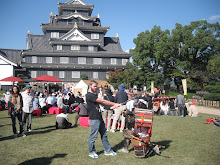
Okayama Castle was built in 1597. It is one of only a few castles in Japan that was painted black which earned the nickname "Crow Castle". It was destroyed by bombings in 1945, then reconstructed in 1966; This time entirely from concrete, Thus todays castle is only a replica.
Korakuen Garden was built on its own island in the middle of the Asahi River on the eastern side of Okayama City, adjacent from the castle, which is visible from inside. The garden's construction was finished in 1700, But needed rebuilding in 1934 due to flooding, and again in 1945 due to bombings of World War II. The garden is said to be in the top three of Japan's gardens.
My visit to the castle and garden were on the same day, October 12th, which was a national holiday here in Japan; National Sports Day. From what I understand, this holiday, is for nothing less than having a good day in the sun with your family and friends. In Japan, the work force works very hard hours, sometimes up to 16 hours daily. They have many national holidays which are much needed to give the workers a rest now and then, and of course, to give us foreigners some cultural experiences!
The castle and garden was one of my favorite days so far in the two months since I've been abroad. The Following are my photos from that day!
These three photos were taken outside both the garden and castle. They are of the festival that was happening due to the holiday. Lots of people enjoying some tasty Japanese food!


Next are pictures from inside the Castle grounds. I even got to take a picture with a Samurai!


Next are photos from inside Korakuen Garden.


Korakuen Garden was built on its own island in the middle of the Asahi River on the eastern side of Okayama City, adjacent from the castle, which is visible from inside. The garden's construction was finished in 1700, But needed rebuilding in 1934 due to flooding, and again in 1945 due to bombings of World War II. The garden is said to be in the top three of Japan's gardens.
My visit to the castle and garden were on the same day, October 12th, which was a national holiday here in Japan; National Sports Day. From what I understand, this holiday, is for nothing less than having a good day in the sun with your family and friends. In Japan, the work force works very hard hours, sometimes up to 16 hours daily. They have many national holidays which are much needed to give the workers a rest now and then, and of course, to give us foreigners some cultural experiences!
The castle and garden was one of my favorite days so far in the two months since I've been abroad. The Following are my photos from that day!
These three photos were taken outside both the garden and castle. They are of the festival that was happening due to the holiday. Lots of people enjoying some tasty Japanese food!


Next are pictures from inside the Castle grounds. I even got to take a picture with a Samurai!


Next are photos from inside Korakuen Garden.


Saturday, October 24, 2009
SIGHTS OF TOKYO
I only had one full day in Tokyo, so we made the best of it going to multiple places by dealing with the intensely packed train system once more. We got off the train at Shinbuku station, which is said to the busiest train station in the world dealing with nearly 1,000,000 passengers daily and proceeded to see Harajuku, the Meiji Shrine, and Shibuya, and went to the top of the Tokyo Government building which gives you a panoramic view of the whole city (or as far as your eyes can see; I honestly never saw the end while in the city). 


This last piece is about the Tokyo Government building. You are able to ride the elevator up about 40 floors into a huge room filled with windows which creates a panoramic view of the entire city (or as far as you can see before your eyes quit working!). This was a truly astonishing moment for me. I had never even seen the biggest cities in my own country and to see the entirety of Tokyo from about was fantastic. you could see everything from up there; including all the places we had gone earlier in the day and the mass of the shrine. Here are my photos which were taken from all directions from the building to show how far it goes on.


Harajuku is an area of Tokyo known for its outrageous youth culture. Here our main visit was on the street called “Takeshita-dori”. This street is basically a youth shopping district selling anything you can think of that the Japanese youth might want to purchase for their unbelievable fashion sense that really has nearly no rules as you would see in America. I noticed first off, that being as wacky as possible in your dressing is the style, rather than five or six main ideas. I saw girls wearing skirts that barely cover their butt cheeks along with boots of random colors and patterns that rise up past there knee caps. And to top off that outfit, they would wear even more nutty stockings that would be seen between the skirt and boots and have a purse with BARBIE written in pink on it. I saw more guys with girly hair cuts than at a bless the fall concert, as well as more T-shirts than I can count with nonsense English sayings on them like; PIE EATS, or SHOOT THE MOON. All and all, Harajuku was a great experience to see what the youth life in Tokyo is all about.

If you ever have the chance to see Tokyo, and you like Japanese tradition, I highly recommend you check out the Meiji Shrine, or Meiji Jingu in Japanese. This is a huge park containing a Japanese garden, walking trails and of course the shrine dedicated to the Meiji period of Japan, where the country went through the “Meiji restoration”; a huge turning point in modernization for Japan, not only in infrastructure, but also the ways in which daily life was lived for many people, and how the governmental system was treated.

Once you enter the gates and start to walk into the park you will completely forget that you are in a city of over 10 million people. All of the sounds of the city disappear and all that is left is the beauty of Japan’s plant and animal life. It was a very surreal place. Once you reach the main part of the shrine park, you will come across a wooden box standing about waist high with water pouring out of a faucet poking up from the middle. On top of the box are wooden ladles. These ladles are used for the traditional washing of your hands and mouth before entering the shrine itself. You are meant to take the ladle in one hand, fill it with water from the box, and wash one hand at a time with the water that you pour over them with the ladle. Once you have washed both hands you are to pour some into one palm, toss it in your mouth, and swish it around before spitting it out on the ground. Once you are clean, you dip the ladle one last time, hold it cup side up, and let the water run down the handle to wash it as well, so it isn’t dirty for the next visitor.

Inside the shrine, there are little pieces of wood that you can buy for 500 Yen (equivalent to about $5), on which you can write your hopes and dreams. Many of these, people had written things about hoping to pass exams, wishing a sick family member better, or wanting to have a safe journey through life. There were no boundaries on what you could write, just whatever you wanted to come true.
As you walk into the main floor of the shrine, there was yet another wooden box lined on top with dowels evenly spaced. Here you were meant to take coins (in Japan coins range from 1 yen, or a penny, to 500 yen, about $5) and toss them one by one into the box. As they hit the dowels, they would bounce around and make a sound that can only be heard by doing this, before falling to the bottom. I think that this action was much like a wishing well of sorts. The money was to represent, once again your dreams and ambitions, and there was no limit to the amount you could toss into the box. It was your money after all! This act is very traditional and is well known in Japanese society. Many people come here each year to take part in it.

While at the shrine, I got to see a traditional wedding procession. The bride and groom, along with their wedding party (probably close friends and relatives), start at one end of the courtyard and walk very slowly in a line to the other end, up to the side of the shrine, and then inside. We didn’t get to see the actual wedding itself, just the walk, but that was enough to understand the great meaning behind it. I can’t imagine how much it must mean to a Japanese couple to be married in the shrine. The group of people were very well dressed as you might imagine, and the bride and groom looked best of all, being shaded by an umbrella as they strolled across.


This is the traditional garden that was built inside the shrine. It contained a big pond filled with coy, the size of no other coy I had seen before. Now I have come to see coy in many places here in Japan, Some much bigger than these. It also had many wonderful plants which may have been even better in spring time or late fall when the colors are at their peak, yet still magnificent, and a tea house.


Shibuya is the type of place in Tokyo that we see in movies on a regular basis. Thousands of people out going about their daily life, huge video screens on the high rise buildings basically on every corner, shouting advertisements at you in Japanese, and best of all for me was the crosswalk I came upon. This was something I never thought I would see in my life and was incredible. There were two massive streets that came to an intersection. Crossing each street from corner to corner, just like in the states were four crosswalks. In addition to those four, they had added two more that crossed the middle in an X shape to give the most passing room to the hoards of people crossing. Everyone would wait while the cars passed first; nearly a thousand people for each turn of the light were waiting for their turn. Once the lights turned red for the cars, all of these people would hit the street crossing in all directions like ants running form a rain storm. You really had to pay attention, because due to the X shaped crosswalks, people might be walking right in front of you at any second. It was mass chaos for me, but this was all part of normal life in Shibuya. If I have another chance while in Japan, this is one place that I couldn’t miss.


This last piece is about the Tokyo Government building. You are able to ride the elevator up about 40 floors into a huge room filled with windows which creates a panoramic view of the entire city (or as far as you can see before your eyes quit working!). This was a truly astonishing moment for me. I had never even seen the biggest cities in my own country and to see the entirety of Tokyo from about was fantastic. you could see everything from up there; including all the places we had gone earlier in the day and the mass of the shrine. Here are my photos which were taken from all directions from the building to show how far it goes on.


Subscribe to:
Posts (Atom)